
Roosevelt, Saint Gaudens and the Rebirth of American Coinage
By Silvano DiGenova, CEO Tangible Investments
“Roosevelt forced the United States Mint to treat American coinage as something more than efficiently produced money. He demanded art worthy of a rising world power.”
When I consider the great American coins of the twentieth century, the story begins with Theodore Roosevelt. On December 27, 1904, he sent Treasury Secretary Leslie M. Shaw a short letter containing an unusually blunt assessment: “I think our coinage is artistically of atrocious hideousness.” He then asked whether an artist of Augustus Saint-Gaudens’ caliber could be engaged to create coins with genuine beauty.
That letter helped launch the most consequential artistic transformation in the history of United States coinage.

Roosevelt did not redesign every American denomination in 1907, as the story is sometimes abbreviated. His achievement was broader. He used the presidency to challenge the United States Mint’s established practices, bring leading sculptors into coin design and insist that American money express the ambition of a nation rising to global prominence. The immediate results included the gold coins of 1907 and 1908 and the Lincoln cent of 1909. The standard endured long after his administration ended.
For collectors, this period produced some of the most beautiful, historically important and highly sought-after coins ever struck by the United States.
Looking Back to Move American Coinage Forward
Roosevelt understood something the ancient Greeks had demonstrated more than 2,000 years earlier: a coin could function as money while remaining a serious work of art. It could record what a civilization valued and which events deserved to be preserved in metal.
His frame of reference was the ancient world. Roosevelt and Saint-Gaudens admired the sculptural authority of Greek coinage, particularly its bold relief, natural movement and ability to communicate civic power on a small metal surface. In a November 1905 letter, Roosevelt told Saint-Gaudens that he had been studying gold coins of Alexander the Great and was struck by their high relief.
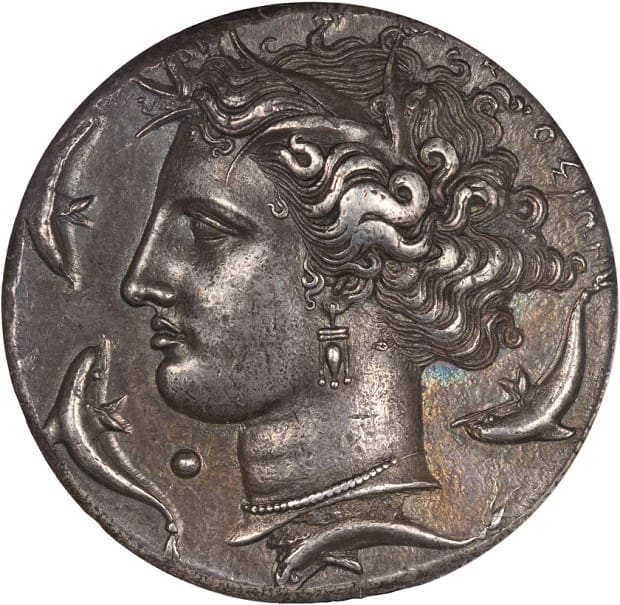
Any experienced collector can understand the attraction. Greek tetradrachms and the celebrated decadrachms of Syracuse possess a depth and vitality that much later coinage never equaled. They were money, but also miniature sculpture at a level Roosevelt believed modern America should match.
Roosevelt was not asking Saint-Gaudens to copy an ancient coin. He wanted American coinage to equal the authority of antiquity while expressing distinctly American ideas. The result would be classical in execution, but American in purpose.
Roosevelt and Saint-Gaudens
Roosevelt chose Augustus Saint-Gaudens because he was among America’s most accomplished sculptors. He admired his public monuments, particularly the equestrian monument to General William Tecumseh Sherman in New York. Saint-Gaudens had also designed Roosevelt’s 1905 inaugural medal, demonstrating that he could translate monumental art into relief.
Their collaboration focused first on the $10 eagle and $20 double eagle. Saint-Gaudens treated both as sculpture rather than routine adaptations of Mint convention. His ambition for the double eagle was to create, in his words, “a living thing and typical of progress.” Combined with Roosevelt’s insistence on greater relief, that ambition separated the project from the cautious design culture preceding it.
The eagle and double eagle offered distinct expressions of the same program. Each drew upon classical principles while asserting an American identity, and each carried the authority of a major sculptor rather than the uniformity of the Mint’s conventional engraving process. Together, they established that federal coinage could be treated as public art.
The Ultra High Relief Experiment
Before Roosevelt’s intervention, the Mint’s regular coinage reflected a production system that favored consistency and efficiency over sculptural depth. Most designs were prepared within the Mint’s own engraving establishment and modeled in relatively shallow relief so they could be brought up with a single blow from high-speed coining presses. The approach improved die life, supported large mintages and produced coins that stacked and circulated reliably. By the opening years of the twentieth century, however, those practical requirements had hardened into an artistic convention. Roosevelt regarded the resulting coinage as competent manufacture, but inadequate national art.
Against that background, his preference for high relief was far more than a stylistic adjustment. Roosevelt wanted the double eagle to recover the medallic presence of ancient Greek coinage. The aesthetic objective was extraordinary, but it placed Saint-Gaudens’ sculptural method in direct conflict with the Mint’s machinery, production schedules and longstanding assumptions about what a circulating coin had to be.
Saint-Gaudens’ assistant Henry Hering later described the experimental striking process. A single blow from the hydraulic press brought up only part of the design, and the relief emerged more fully with each succeeding strike. Hering recalled that the complete design did not appear until the ninth impression. The process could produce a masterpiece, but it could never support the speed or volume required for circulating coinage.
Those experiments produced the 1907 Ultra High Relief double eagle, one of the great prizes in American numismatics. PCGS records a mintage of 22 and estimates that approximately 15 lettered-edge examples survive. These pieces preserve the design closest to Roosevelt and Saint-Gaudens’ sculptural ideal, before the necessities of mass production compelled further compromise.
The relief was reduced for the MCMVII High Relief double eagle. The Mint’s 1908 annual report records that 12,153 were struck on medal presses for broader distribution, yet even this version remained too demanding for ordinary production. A further reduction allowed the design to be struck efficiently on standard coining presses. The sequence is central to understanding the 1907 issues: the Ultra High Relief embodies the artistic ideal, the High Relief records the effort to make that ideal more practical, and the regular low-relief issue represents the accommodation required for national circulation.
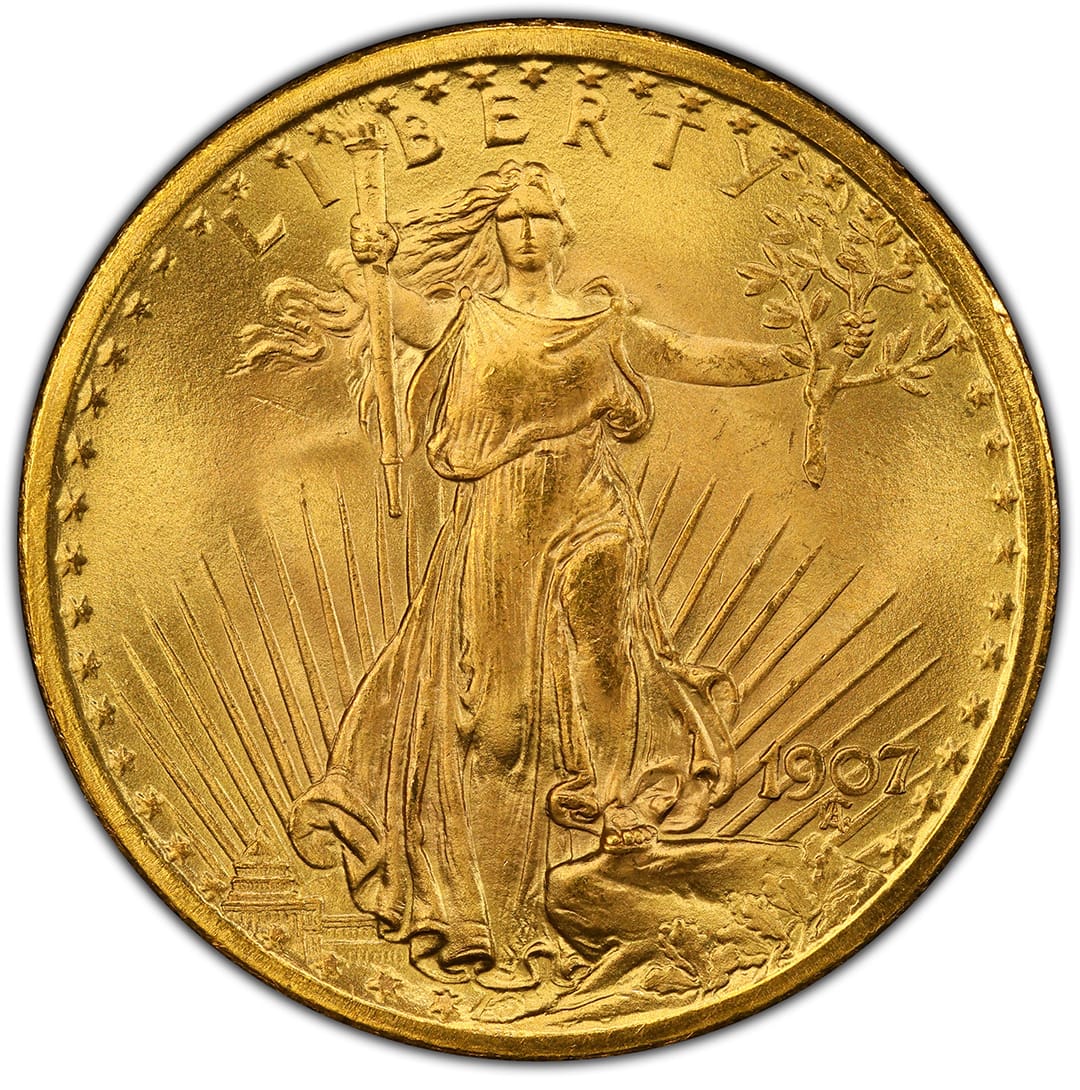
Low Relief
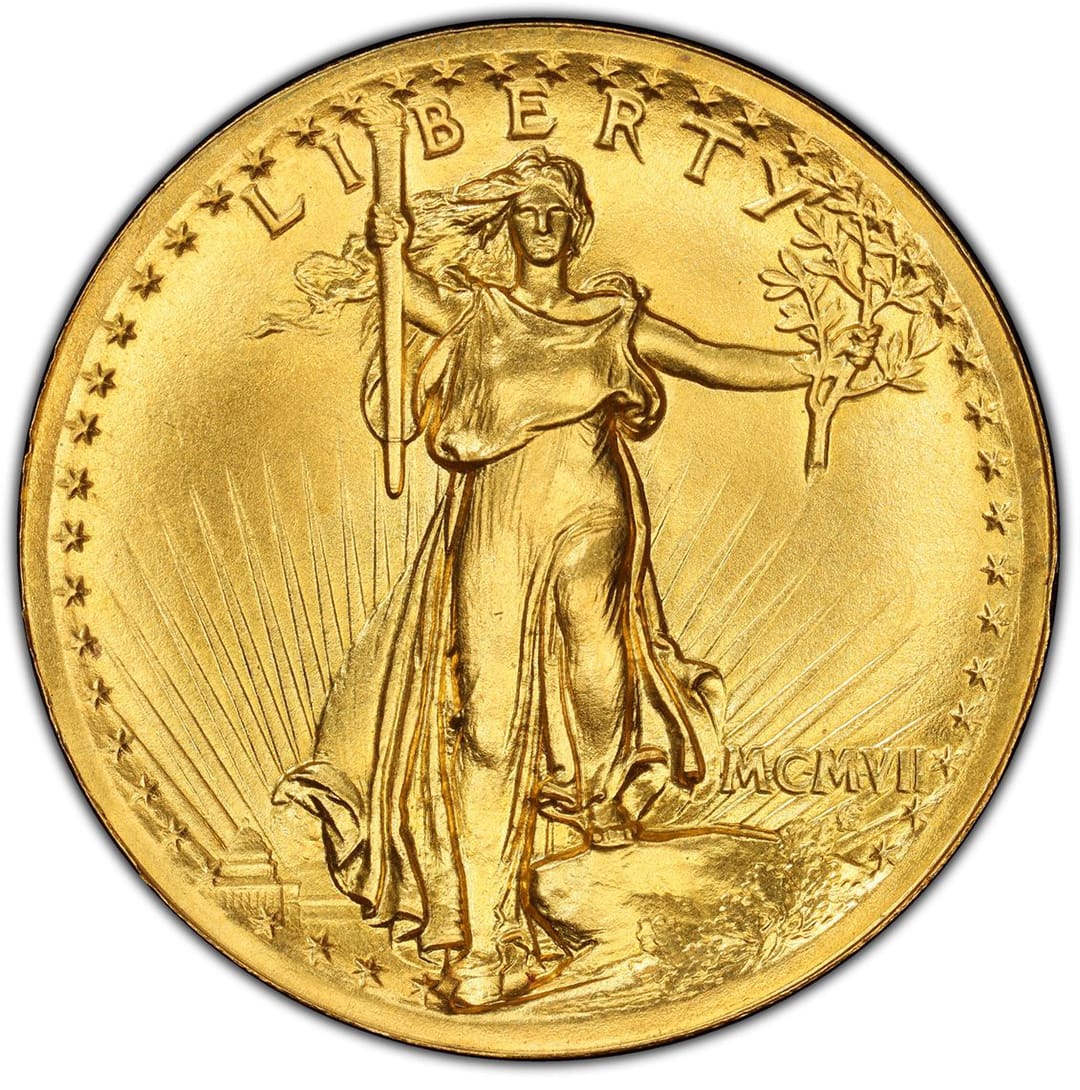
High Relief
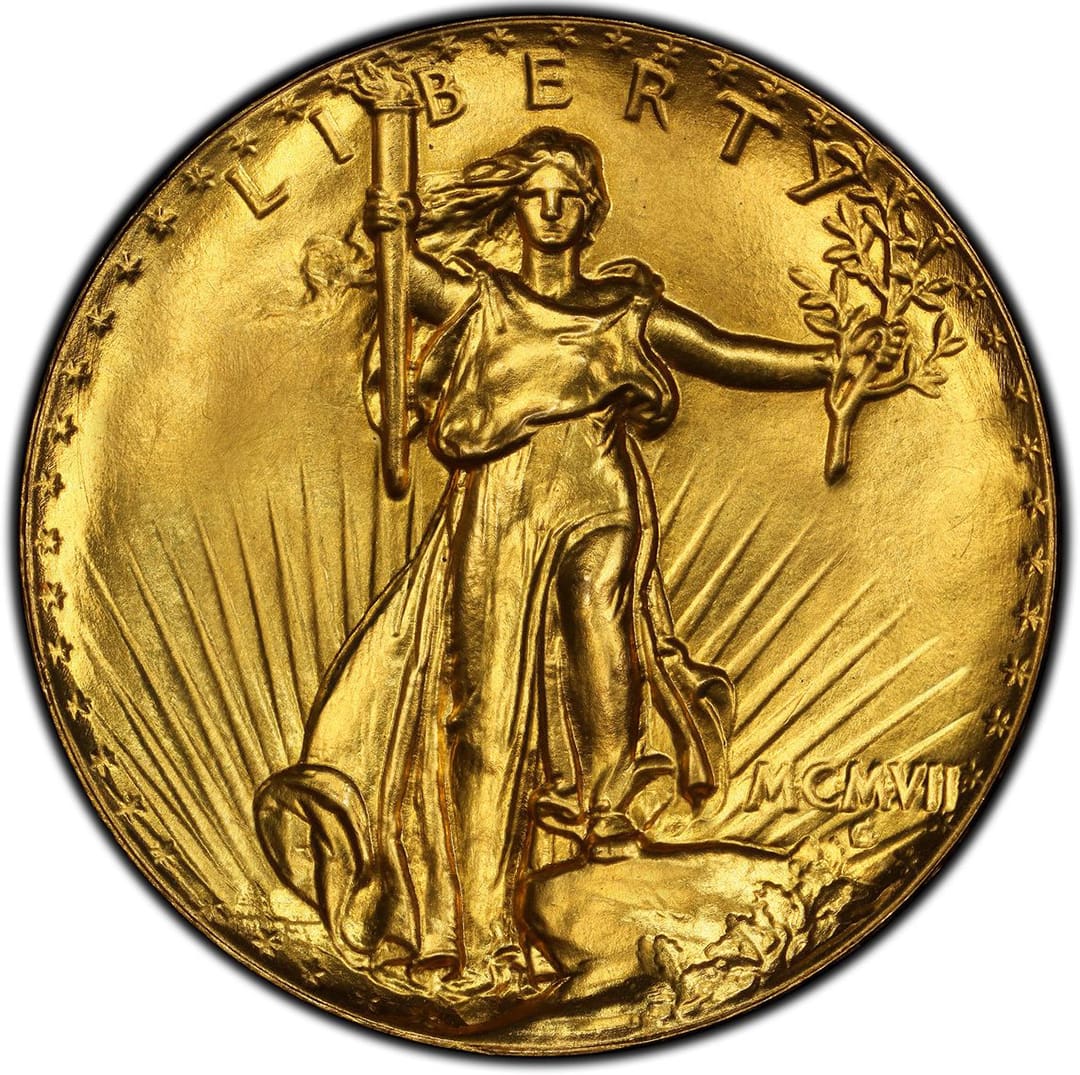
Ultra High Relief
A Coin With a Special Place in Tangible Investments’ History
The Ultra High Relief also occupies a special place in the history of Tangible Investments. In 1999, I bought, then sold, a 1907 Ultra High Relief $20 PCGS Proof-67 Norweb specimen for a client. The $1.21 million amount when the hammer fell made it the first gold coin ever sold at public auction for more than $1 million.
I mention that transaction because it illustrates what discerning collectors recognize at the highest level. The coin combined extreme rarity and exceptional preservation with artistic distinction, an important pedigree and a direct connection to a defining episode in American coinage. When those qualities converge, the market understands their significance.
The Unique Indian Head $20 Pattern
If I had to identify one coin that captures the ambition of the project, the unique 1907 Indian Head $20 gold pattern, Judd-1776, would be near the top of the list. It preserves a consequential alternative considered during development of the Saint-Gaudens double eagle, an artistic decision that never reached regular production.
PCGS records a mintage and estimated survival of one. The coin has passed through the collections of Waldo Newcomer, F.C.C. Boyd and King Farouk of Egypt. In my opinion, it belongs in any serious discussion of the most important American coins. Its uniqueness, artistic quality, pedigree and place in the development of the Saint-Gaudens coinage are virtually impossible to duplicate.
Patterns allow collectors to study alternatives considered before a final design entered production. Judd-1776 is especially revealing because it could have changed the identity of America’s largest circulating gold denomination. Few unrealized possibilities carry comparable artistic or historical weight.
Roosevelt’s Broader Coinage Legacy
Roosevelt’s influence extended beyond the two Saint-Gaudens denominations. Once the Mint confronted the practical limits of high relief, Dr. William Sturgis Bigelow proposed an entirely different solution: recess the design below the coin’s flat field. Sculptor Bela Lyon Pratt developed the concept for the Indian Head $2.50 quarter eagle and $5 half eagle introduced in 1908.
The Pratt issues were unlike any previous regular-issue United States coins. Collectors pursue them as distinctive types and through major rarities such as the 1911-D quarter eagle and the 1909-O and 1929 half eagles. They addressed the relief problem from the opposite direction by placing the principal design elements below the field.
Roosevelt also helped initiate the Lincoln cent. Victor David Brenner’s portrait of Abraham Lincoln impressed him, and the Treasury adopted it for the cent commemorating the centennial of Lincoln’s birth. Released on August 2, 1909, shortly after Roosevelt left office, it became the first regular circulating United States coin to portray an actual president. The 1909-S VDB remains one of the most recognizable key dates in American collecting.
The artistic renaissance continued beyond Roosevelt’s presidency. The Mercury dime, Standing Liberty quarter and Walking Liberty half dollar arrived in 1916 from artists outside the Mint’s traditional engraving establishment. Roosevelt did not commission them, but they followed his standard: circulating money deserved the attention of serious artists and could be judged as public sculpture.
Why Collectors Still Pursue Roosevelt-Era Coinage
Not every coin associated with this period is rare, and that breadth is part of its appeal. A collector can begin with a common-date Saint-Gaudens double eagle or pursue a trophy rarity that may appear only once in a generation.
The 1907 Ultra High Relief and High Relief double eagles stand at the center of the story because they record the closest encounter between ancient sculptural principles and modern American coinage. The Indian Head eagle represents another essential Saint-Gaudens type. The Pratt quarter eagle and half eagle introduced an incuse format never repeated on another regular United States series. The Lincoln cent changed the nation’s approach to portraiture on circulating money, while Judd-1776 preserves the most important unrealized alternative from the period.
Within each series, the fundamentals remain decisive: rarity, grade, strike, surfaces, color, eye appeal and pedigree. A coin does not become important simply because it is old or made of gold. The finest examples carry a specific reason to be collected. A 1907 High Relief records the original transition. An Ultra High Relief preserves Saint-Gaudens’ conception in its most sculptural form. Judd-1776 represents an artistic possibility embodied in a single known gold coin.
After more than four decades in the rare-coin market, I continue to favor coins that unite artistic quality with genuine historical importance. Roosevelt’s coinage renaissance is one of the clearest American examples. These pieces arose from a president’s dissatisfaction with institutional convention, an artist’s determination to match the achievements of antiquity and a Mint compelled to adapt its methods to an unfamiliar level of ambition.
Roosevelt believed that a great country should produce great coinage. More than a century later, the finest products of his campaign remain among the standards by which American numismatic art is measured.
PROTECT YOUR WEALTH. CONTACT US TODAY
If you are interested in protecting or even growing your wealth through the investment of rare coins, we invite you to contact us. At Tangible Investments, we have over 40 years of numismatic expertise and are proud members of PCGS, CAC, and PNG. One of our experts can guide you in reaching your financial goals, ensuring that your investments are tailored to your specific needs and objectives.