
Gold and Silver Moved Before the War. The Long-Term Case Remains
By Silvano DiGenova, CEO Tangible Investments
“That back-and-forth created the “Iranian Rollercoaster.” But the most important point is this: the rollercoaster did not create the original ride higher in gold and silver. It created the volatility that followed. ”
The recent movement in gold and silver has felt like a rollercoaster, and in many ways, that is exactly what it has been.
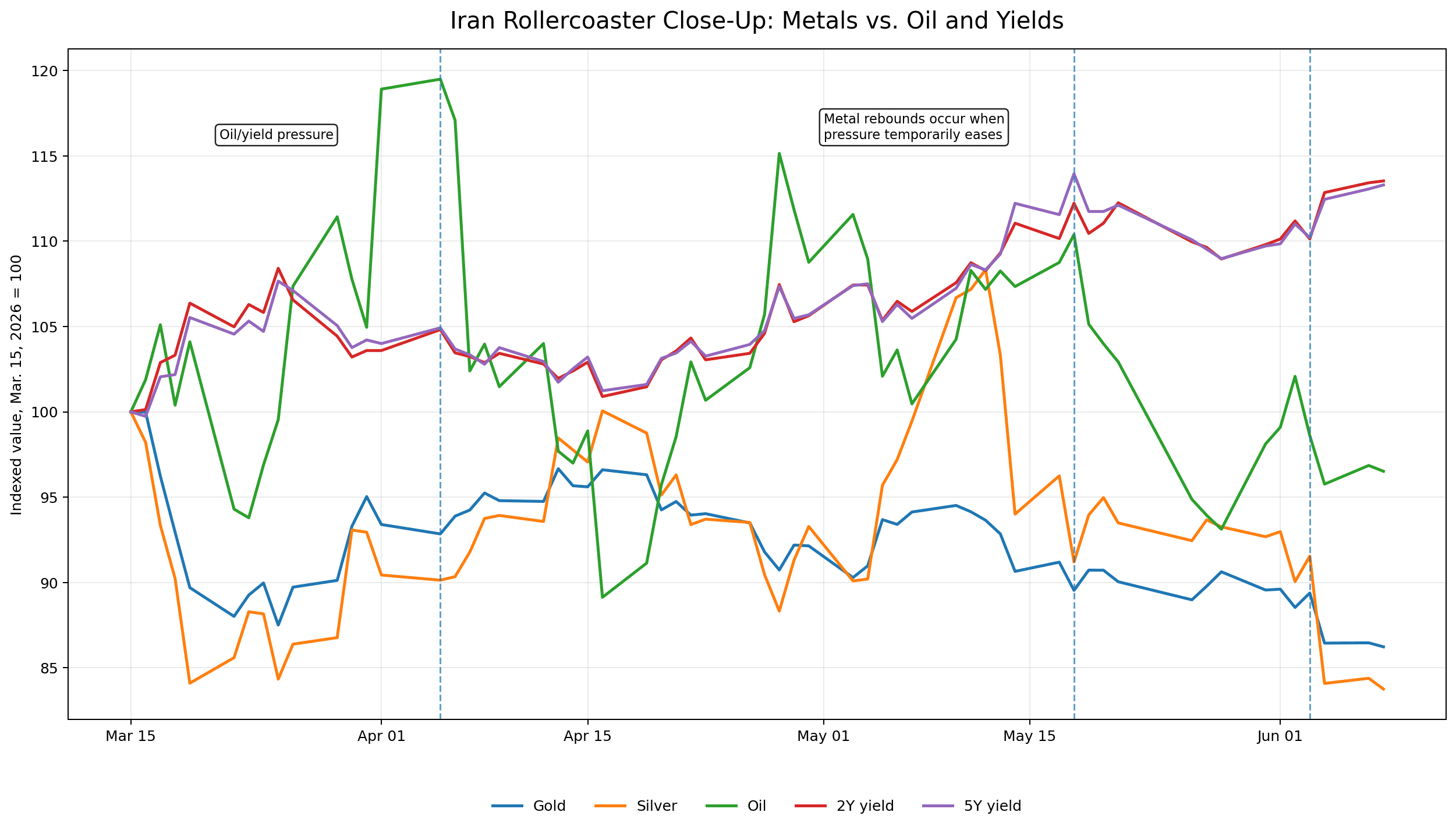
Prices climbed before the Iran conflict became the dominant public concern, then pulled back as the conflict pushed oil prices higher, inflation concerns returned, and bond yields moved against precious metals. Then came the repeated false starts: signals from the current administration that ceasefire negotiations were progressing, followed by renewed escalation, followed by another round of market reversal.

Each time the market saw a possible path toward a ceasefire, oil prices eased, bond yields softened, and gold and silver began to recover. Each time tensions escalated again, oil prices moved higher, yields firmed, and precious metals came under renewed pressure.
That back-and-forth created the “Iranian Rollercoaster.” But the most important point is this: the rollercoaster did not create the original ride higher in gold and silver. It created the volatility that followed.
The major move in gold had already taken place before the market was focused on a possible military conflict with Iran. Silver had also participated in the broader precious metals rally, supported by both monetary demand and industrial demand. That tells us the original move was not simply a war trade.
The foundation was much deeper.
Gold and silver were responding to structural concerns that had already been building across the financial system: rising U.S. debt, persistent deficits, higher interest costs, heavy Treasury issuance, concern over the long-term purchasing power of the dollar, central-bank demand, and the growing recognition that precious metals remain among the few assets outside the paper financial system.
The Iran conflict changed the short-term trading environment. It did not erase the long-term case.
That distinction matters for investors because the war will eventually end or stabilize. Oil prices should eventually return to more manageable levels if supply disruption does not become permanent. The inflation pressure tied to that oil shock should ease. Bond yields may soften as the market becomes less concerned about energy-driven inflation.
When that happens, the market may return to the same foundational reasons gold and silver moved higher in the first place.
And that is why pullbacks in this environment should not be viewed only as weakness. They may provide an opportunity to establish or add to a long-term position at more attractive prices.
Why Gold and Silver Ran Before the War
The major move in gold happened before the market was focused on a military conflict with Iran. Silver also made a powerful move, supported by both monetary demand and industrial demand.
That is the key point.
The original rally was not caused by one geopolitical event. It was driven by structural concerns that had already been building across the financial system.
The United States continues to carry an extraordinary debt burden. Federal deficits remain large. Interest costs are rising. Treasury issuance remains heavy. Investors are asking how long the government can continue borrowing at this scale without consequences for the purchasing power of the dollar.
This does not mean the United States is facing an immediate default. That is not the issue. The issue is confidence.
Confidence in currency. Confidence in Treasury debt. Confidence in the ability of paper assets to preserve value over long periods of time.
Gold responds directly to those questions because gold is not someone else’s liability. It is not a Treasury bond. It is not a bank deposit. It is not a corporate obligation. It does not depend on the solvency of an issuer. It cannot be printed.
Silver is different, but related. Silver has monetary characteristics, but it also has major industrial uses. That makes it more volatile than gold, but it also gives silver an additional demand driver when industrial consumption is strong. Solar technology, electronics, electrification, and advanced manufacturing all require silver. When monetary demand and industrial demand rise at the same time, silver can move very aggressively.
That is what made the early move in precious metals so powerful. Gold was responding to debt, reserve diversification, and confidence concerns. Silver was responding to many of the same monetary concerns, while also benefiting from strong industrial demand.
Central Banks and Investors Are Sending a Clear Signal
Central-bank buying has been one of the most important supports for gold.
Central banks do not buy gold because of one news cycle. They buy gold because it serves a strategic purpose. It diversifies reserves. It carries no counterparty risk. It exists outside the direct control of another nation’s financial system.
That kind of demand is structural. It is not speculation. It reflects a long-term reassessment of gold’s role as a reserve asset.
Private investors have also returned to gold and silver because the traditional balance between stocks and bonds has become less reliable. In a world where inflation, debt, and interest-rate uncertainty can pressure both stocks and bonds, precious metals offer a different kind of protection.
Gold is the cleaner reserve and monetary hedge. Silver is the higher-volatility companion, with both monetary and industrial upside.
Together, they represent a way to hold value outside the paper financial system.
How the Iran Conflict Created the Pullback
When the Iran conflict escalated, many investors expected gold and silver to rise because war usually increases uncertainty. That would be the simple explanation.
But the market reaction was more complicated.
The conflict pushed oil prices higher. Higher oil prices raised inflation concerns. Higher inflation concerns made investors question whether the Federal Reserve would be able to cut interest rates. That pushed bond yields higher.
That became a short-term headwind for precious metals.
Gold does not pay interest. When Treasury yields rise, especially when real yields rise, the opportunity cost of holding gold increases. Silver is even more volatile because it trades as both a precious metal and an industrial metal. When yields rise and investors reduce risk, silver can pull back sharply.
That is why the war did not simply lift precious metals. It created competing forces.
Geopolitical fear supported gold and silver. But oil-driven inflation and higher bond yields pressured them.
In that environment, precious metals were not trading only as crisis hedges. They were trading against the bond market.
Why the Volatility Became So Extreme
The ceasefire negotiation process created repeated reversals.
Each time the current administration signaled progress toward a possible ceasefire, markets began to price in a more stable energy environment. Oil prices eased. Inflation concerns cooled. Bond yields moved lower. Gold and silver recovered.
Then, when military escalation returned, the opposite happened. Oil moved higher. Inflation concerns returned. Bond yields firmed. Precious metals weakened again.
That is why the market felt unstable. The same conflict was producing different outcomes depending on whether traders were focused on war risk or oil-driven inflation risk.
Ceasefire optimism helped precious metals not because it increased fear, but because it reduced the inflation and yield pressure that had been weighing on the market.
Escalation pressured precious metals not because gold and silver stopped being safe-haven assets, but because higher oil prices threatened to keep inflation elevated and interest rates higher for longer.
That distinction matters.
The volatility was not proof that the precious metals thesis had failed. It was proof that short-term traders were constantly recalculating the relationship between war, oil, inflation, bond yields, and Federal Reserve policy.
Pullbacks Can Create Opportunity
This is where long-term investors need to be careful.
A pullback in gold or silver can feel uncomfortable in the moment, especially when the headlines are intense. But if the underlying reasons for the original rally remain in place, those pullbacks can create an attractive entry point.
The war will eventually end or stabilize. Oil prices should eventually normalize if supply disruption does not become permanent. Inflation expectations tied to the oil shock should cool. Bond yields may soften as the market becomes less concerned about energy-driven inflation.
When that happens, one of the major short-term pressures on precious metals may subside.
But the foundational reasons for owning gold and silver will still remain.
The debt problem will still be there. Deficits will still be there. Heavy Treasury issuance will still be there. Central-bank diversification will still be there. Concerns about the purchasing power of paper currency will still be there. Industrial demand for silver will still be relevant.
That is why pullbacks should not be viewed only as weakness. In a structural bull market, pullbacks can provide investors an opportunity to establish or add to a long-term position at a more attractive price.
The key is understanding the difference between a broken thesis and temporary volatility.
I do not believe the long-term precious metals thesis is broken.
What Analysts Are Saying
Respected market analysts continue to point to many of the same forces.
The World Gold Council has emphasized that gold’s strength has been supported by geopolitical and economic uncertainty, a weaker dollar, investor demand, and central-bank allocations. The World Bank has also pointed to central-bank buying and uncertainty as key supports for gold, while noting that precious metals have benefited from both safe-haven demand and broader economic instability.
J.P. Morgan has maintained a bullish longer-term view on gold, citing strong central-bank and investor demand, and has also highlighted silver’s powerful upside potential tied to global demand. Goldman Sachs has also pointed to sustained demand from key buyers as a reason gold can remain supported.
There are always risks. Higher real yields, a stronger dollar, reduced industrial demand, or profit-taking can pressure prices. Silver in particular can be very volatile because it is both a monetary metal and an industrial metal.
But the broad analyst guidance remains clear: gold and silver are not being driven by one headline alone. They are being supported by a combination of debt concerns, central-bank demand, currency uncertainty, investor diversification, and, in silver’s case, industrial demand.
What Happens After the War?
When the Iran conflict ends or stabilizes, some fear premium may leave the precious metals market. That would be normal.
But the end of the war could also remove one of the biggest recent headwinds: oil-driven inflation pressure.
If oil prices normalize, inflation expectations may ease. If inflation expectations ease, bond yields may stop rising or move lower. If yields ease, gold and silver no longer have to fight the same opportunity-cost pressure they faced during the conflict.
That could allow the market to return to the original reasons precious metals moved higher.
Gold would likely return to trading on debt, currency confidence, central-bank demand, and real yields.
Silver would likely return to trading on a combination of monetary demand, investor flows, and industrial consumption.
That is a constructive setup for long-term holders.
Gold and silver did not make their major move because of the Iran conflict. They moved before the war became the market’s focus.
The conflict created the pullback and the volatility. Escalation pushed oil and bond yields higher, which pressured precious metals. Ceasefire optimism brought oil and yields lower, which allowed gold and silver to recover.
That pattern tells us the market was not abandoning precious metals. It was working through a temporary macro shock.
The long-term case remains.
Gold remains one of the few assets that does not depend on anyone else’s promise. Silver remains both a monetary metal and a critical industrial metal. Both continue to benefit from a world defined by high debt, currency concerns, central-bank diversification, and uncertainty around traditional financial assets.
That is why pullbacks can be opportunities.
The war will end. The oil shock will fade. The volatility will subside.
But the foundational reasons precious metals ran in the first place are still here.
PROTECT YOUR WEALTH. CONTACT US TODAY
If you are interested in protecting or even growing your wealth through the investment of rare coins, we invite you to contact us. At Tangible Investments, we have over 40 years of numismatic expertise and are proud members of PCGS, CAC, and PNG. One of our experts can guide you in reaching your financial goals, ensuring that your investments are tailored to your specific needs and objectives.