
DMPL Dollars. Rare by the Numbers, Undervalued in the Market.
By Silvano DiGenova, CEO Tangible Investments
“The opportunity lies in finding an exceptional coin whose scarcity and appeal are not yet fully reflected in its price.”
Morgan silver dollars rank among the two or three most collected coin series in the world. If we consider the amount of money collectors spend worldwide, I believe they may occupy the number one position. Numerous books have been written about the series, generations of collectors have pursued it, and demand continues to grow.
Within Morgan dollars is a special category: coins with deeply mirrored fields and, in some cases, dramatic cameo contrast. These resemble proofs and are referred to as Deep Mirror Prooflike dollars, commonly called DMPLs.

Prooflike surfaces can appear on the earliest coins struck from new or freshly polished dies. As those dies are used, the reflectivity diminishes. The number of mirrored coins produced varies by date, mint, and die. Far fewer survive with the depth of reflection and well-preserved surfaces that make a truly exceptional DMPL so desirable.
These coins can be extraordinarily beautiful. In my experience, most collectors given a choice between two Morgan dollars of comparable quality would prefer the one with deep mirrors. Yet I believe the market often places a surprisingly modest premium on that combination of beauty and scarcity.
The Appeal And Scarcity Of Deep Mirrors
The mirror finish presents a challenge as well as an attraction. Marks and hairlines that might be less noticeable on an ordinary Mint State dollar can be conspicuous against reflective fields. Years of handling and contact with other coins have impaired many examples, leaving relatively few with both deep mirrors and well-preserved surfaces.
Consider two of the most available DMPL dates: the 1883-CC and 1884-CC. The combined PCGS and NGC population figures used here show approximately 6,000 or more deep mirror prooflike examples of the 1883-CC across all grades, and approximately 5,000 of the 1884-CC. PCGS uses the designation DMPL; NGC uses DPL. For this discussion, I refer to both as DMPL.
It is no surprise that these Carson City issues are comparatively available. Substantial quantities remained in Treasury storage until their eventual dispersal, including the GSA sales beginning in the early 1970s. Many spent approximately 90 years in bags in vaults, effectively removed from circulation.
Even this prolonged period in storage did not ensure preservation in exceptional condition. Contact between coins left marks on many examples, and high-quality DMPL survivors remain scarce.
In MS64 through MS67, the combined figures show 3,707 DMPL examples of the 1883-CC and 3,652 of the 1884-CC. As a point of reference, the regular, non-DMPL 1883-CC population in MS64 or finer is 53,116. Even for comparatively common DMPL dates, the difference is substantial.
Rarity Versus Price
The relationship between rarity and price becomes apparent when comparing the 1883-CC in MS64 with its DMPL counterpart. As one of the more available DMPL issues, it provides a conservative starting point for assessing relative value.
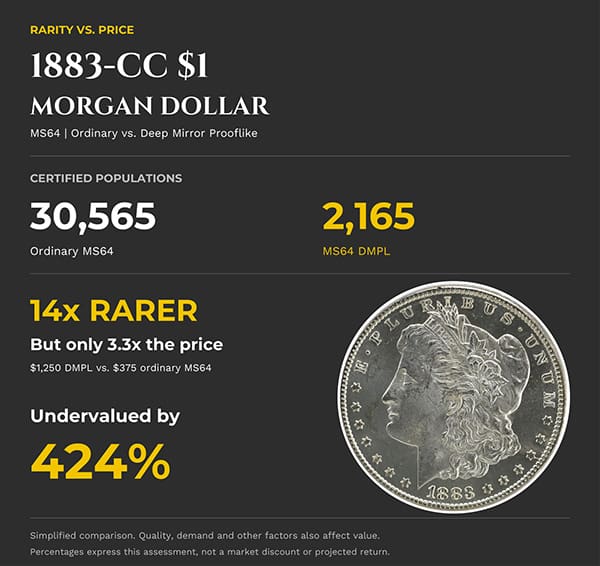
The regular MS64 population is 30,565, compared with 2,165 in MS64 DMPL. The corresponding prices used in this comparison are approximately $375 and $1,250.
For every MS64 DMPL in those reports, there are roughly 14 regular MS64 examples. Yet the DMPL sells for only about 3.3 times the price.
If we simply do the math, 14 divided by 3.3 equals approximately 4.24. Expressed as a relative-value index, that is 424%, or roughly 400% using rounded figures. I interpret this disparity as evidence of approximately fourfold relative undervaluation, even for one of the more common DMPL issues.
A comparison with the widely available 1881-S in regular MS64 strengthens the case. The 1881-S has a reported population of approximately 238,000 and a price of approximately $100. The 1883-CC DMPL has the same population of 2,165 and price of $1,250 used above.
The 1881-S is approximately 110 times more common in those figures, while the DMPL costs only 12.5 times as much. Applying the same calculation, 110 divided by 12.5 equals 8.8, or 880% on this relative-value index. In my view, that illustrates nearly ninefold relative undervaluation.
The Carson City mintmark carries its own appeal, and comparisons between different issues must account for differences in collector demand. Nevertheless, this is a considerable increase in reported scarcity for the premium paid.
The Contrast In A Scarcer Issue
The same relationship can be examined in a scarcer DMPL without selecting an obscure issue. The first year of the Morgan dollar series offers a useful example: the 1878 eight-tail-feather variety, often abbreviated 8TF. I believe this issue is relatively undervalued even without deep mirrors.
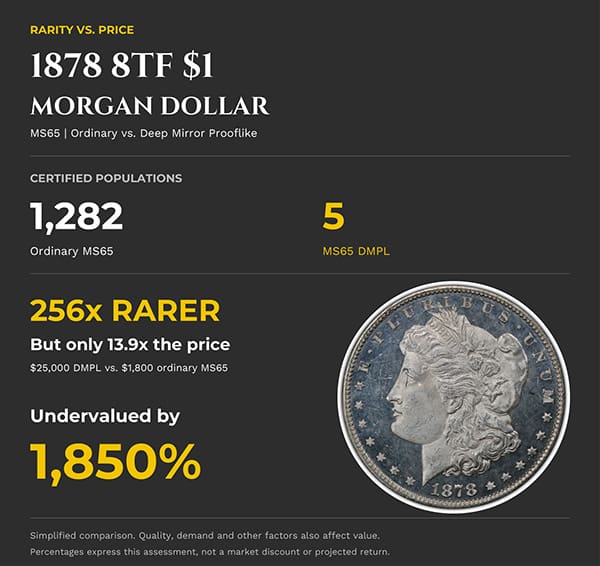
The combined PCGS and NGC figures used here show 1,282 examples in regular MS65, compared with just five in MS65 DMPL. The corresponding prices are approximately $1,800 and $25,000.
For every reported MS65 DMPL, there are approximately 256 regular MS65 examples. Yet the DMPL trades for only about 13.9 times the price.
Using the rounded ratios, 256 divided by 13.9 equals approximately 18.4; using the underlying population and price figures, the result is approximately 18.5. That is about 1,850% on the same relative-value index. I regard this as evidence of approximately 18.5-fold relative undervaluation, a considerably greater disparity than in the 1883-CC comparison.
The contrast becomes more striking against the very common 1881-S Morgan in MS65. The figures used for that comparison show 119,836 regular MS65 examples, priced at approximately $200. Against five 1878 8TF MS65 DMPL examples at $25,000, the common issue’s reported population is nearly 24,000 times larger, while the DMPL costs only 125 times as much. Dividing the rounded population ratio of 24,000 by 125 gives 192, or 19,200% on this relative-value index. By this comparison, the disparity between scarcity and price approaches 192-fold.
These comparisons do not tell the whole story. Certified populations can include repeat submissions, and value also depends on demand, quality, and eye appeal. The relative-value percentages express the population ratio divided by the price ratio, multiplied by 100. They are not percentage discounts from an established fair value or forecasts of investment returns. Nevertheless, the disparities help explain why I regard carefully selected DMPL Morgan dollars as an overlooked segment of the market.
The Designation Must Be Supported By The Coin
There is an essential qualification to this argument. The coin must possess the deep mirrors and surface quality that make the designation desirable.
The market is sprinkled with coins carrying a DMPL designation whose mirrors, in my judgment, are less convincing than the label suggests. Certification provides useful information, but collectors still need to evaluate the coin itself. Paying a premium for an unconvincing example undermines the very reason for buying a DMPL.
We have done a brief auction survey of the 1878 8TF, 1879, and 1879-O issues to illustrate the challenges collectors face in evaluating designated examples.
For the 1878 8TF, nine auction appearances in MS65 or better were identified through PCGS auction records. Two lacked photographs and were excluded. Of the seven remaining appearances, two were judged not to display sufficient mirror quality, approximately 29% of the photographed sample.
For the 1879, there were 28 appearances. Excluding five without photographs and seven repeat appearances left 16 distinct examples. Three were judged insufficiently convincing as DMPLs, representing 18.75% of that sample.
For the 1879-O, two of eight distinct examples raised similar concerns, or 25% of the sample.
Although these small photographic samples cannot establish a misdesignation rate for the entire series, the findings reinforce the importance of careful evaluation. Mirror depth can be difficult to assess from photographs, and coins carrying the same designation may differ substantially in visual appeal.
Why Experience Matters
The distinction has practical consequences. A collector buying on the strength of a label may pay for qualities the coin does not convincingly display. When the time comes to sell, another knowledgeable buyer may see the same shortcomings.
When I evaluate a DMPL, I consider mirror depth, surface marks, contrast, and overall eye appeal together. Whenever possible, I prefer to examine the coin in hand, where qualities that photographs may not adequately convey can be assessed more confidently. For collectors seeking guidance, working with a knowledgeable consultant who physically examines the coin is the best approach.
Understanding the population and price relationships is only part of the process. Recognizing a coin whose mirrors, preservation, and overall appearance justify the premium is equally important.
Value Beyond The Morgan Series
The relative value of DMPL Morgans also deserves consideration alongside other popular series, including Mercury dimes with Full Bands, Standing Liberty quarters, and Walking Liberty halves. Collectors have long recognized the premiums associated with exceptional quality and distinctive characteristics in these series.
In my view, carefully selected DMPL Morgans can offer compelling relative value beside coins in these other popular series. Each comparison must consider the particular date, grade, designation, and demand. The opportunity lies in finding an exceptional coin whose scarcity and appeal are not yet fully reflected in its price.
Morgan dollars already have an enormous collector following. Within that series, truly attractive DMPLs bring together familiar designs, extraordinary surfaces, and limited availability. I believe that combination remains underappreciated in parts of the market.
For collectors who understand the designation and select examples with care, DMPL Morgan dollars offer a compelling combination of beauty and rarity. In my view, their market prices do not always reflect those qualities, leaving meaningful opportunities for knowledgeable buyers.
Put Experience Behind Your Next Purchase
After more than 40 years in numismatics, I believe that buying well begins with understanding exactly what you are buying. A rare coin can offer compelling value, but the grade, surface quality, eye appeal, and price must support the decision.
At Tangible Investments, my team and I put that knowledge to work for collectors. We look beyond the label, assess the qualities that drive desirability, and help you weigh the premium against the opportunity. Our goal is to help you build a collection you can enjoy while making informed decisions that support your long-term financial objectives.
Whether you are looking for an exceptional DMPL, adding to an established collection, or considering the sale of coins you already own, I invite you to speak with us. Let us help you recognize the opportunities, avoid costly mistakes, and put experience behind your next decision.
Contact Tangible Investments to discuss your collection and what you would like to accomplish.
PROTECT YOUR WEALTH. CONTACT US TODAY
If you are interested in protecting or even growing your wealth through the investment of rare coins, we invite you to contact us. At Tangible Investments, we have over 40 years of numismatic expertise and are proud members of PCGS, CAC, and PNG. One of our experts can guide you in reaching your financial goals, ensuring that your investments are tailored to your specific needs and objectives.