
The Coins That Carried a Revolution: Reflections on America’s 250th Birthday
By Silvano DiGenova, CEO Tangible Investments
“As our nation marks 250 years of independence, I think there is real value in remembering that American money, much like American democracy itself, did not arrive fully formed. ”
This year, America turns 250. As someone who has spent over four decades in the rare coin business, I find myself thinking less about fireworks and parades and more about the actual money that passed through the hands of the men and women who built this country. What did a colonial farmer, a Continental soldier, or a Philadelphia merchant actually carry in their pocket in the summer of 1776? The answer says a lot about how young and improvised the American experiment truly was, and it explains why certain coins from this era now command some of the highest prices in all of numismatics.

A Nation Without a Mint
Here is something that surprises a lot of people: the United States did not have its own coinage in 1776. There was no U.S. Mint. There was no dollar bill as we know it. What circulated in the thirteen colonies was a genuine hodgepodge, a reflection of a trading economy that had never been unified under one currency.
The workhorse of the era was the Spanish milled dollar, commonly called a “piece of eight.” These silver coins were so dominant in colonial commerce that they effectively became the model for our own dollar. Because small change was scarce, people would physically cut these coins into wedges called “bits,” which is where the phrase “two bits” for a quarter comes from. Alongside Spanish silver, British halfpennies, shillings, and crowns still circulated widely, since the colonies had long depended on the mother country for coinage. French louis d’or and sous became more common after France allied with the colonies in 1778, and Portuguese gold coins, known as “Joes,” turned up frequently in the southern colonies where trade with Brazil and Portugal was active.
Layered on top of this foreign coinage were a handful of colonial and state issues. Massachusetts had struck its own silver shillings a century earlier, and some of those older Pine Tree and Oak Tree coins were still in pockets during the war. Virginia had received royal authorization in 1773 to strike its own halfpenny, one of the few coins the Crown ever formally sanctioned for a single colony. And as the new states began asserting their independence economically as well as politically, places like Connecticut, New Jersey, Massachusetts, and Vermont started producing their own copper coins, though most of that activity picked up just after the war ended.
Paper was arguably more important than coin during the fighting itself. The Continental Congress issued reams of paper notes to fund the war effort, and that currency depreciated so quickly that “not worth a Continental” entered the American vocabulary as shorthand for something worthless.
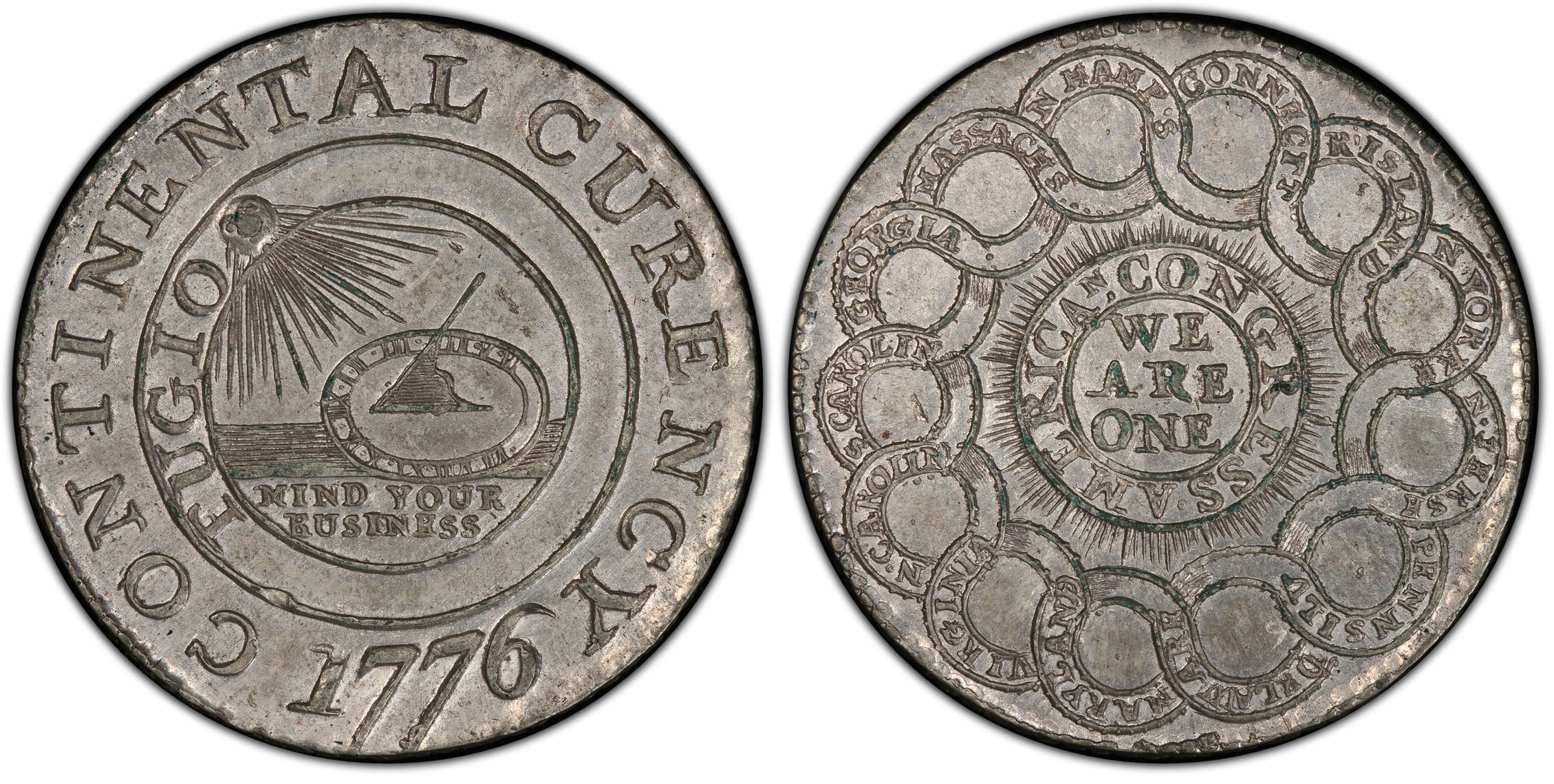
The One True Revolutionary Coin
Of everything that changed hands during those years, one coin stands apart as the closest thing we have to an official coin of the American Revolution: the 1776 Continental Dollar. It was struck in pewter, brass, and in extraordinarily rare instances, silver. Numismatists still debate its exact purpose. Was it meant to circulate alongside Continental paper currency? Was it a pattern piece that never saw wide production? Some researchers have even floated the theory that it was a satirical medal produced in England to mock the collapsing value of American paper money. We may never know for certain, and honestly, that mystery is part of what makes it so compelling to collectors.
What These Coins Bring Today
This is where my world and America’s 250th anniversary intersect most directly. The Continental Dollar has become one of the most valuable series in American numismatics. Depending on the metal and condition, recognized varieties trade anywhere from roughly $9,500 to well over a million dollars. A silver example graded Mint State 63 sold for $1.41 million, and only two silver specimens are known to exist in the entire world. A pewter example, the most commonly encountered metal in this series, set a record at $264,500, even though pewter pieces in mint condition number only around twenty worldwide. I have always found it remarkable that even a well worn example can carry serious value simply because so few of these coins survived at all. There is a well documented case of a pewter Continental Dollar purchased for pocket change at a European flea market that was later authenticated and valued at nearly $100,000.
Beyond the Continental Dollar, the early state coppers from New Jersey, Connecticut, Vermont, and Massachusetts remain popular with collectors. Common varieties in circulated condition might trade for a modest sum, but rare die varieties in high grade can bring five figures. Virginia halfpennies, being more plentiful, typically trade in a more accessible range unless a particularly scarce variety surfaces.
Why This Matters in 2026
As our nation marks 250 years of independence, I think there is real value in remembering that American money, much like American democracy itself, did not arrive fully formed. It was assembled piece by piece, coin by coin, from Spanish silver, British copper, French gold, and a handful of homegrown experiments that nobody was quite sure would work. That improvisation, and the scarcity it left behind, is exactly why these pieces still command such attention and value in the market today.
At Tangible Investments, we have always believed that a coin is more than a metal object. It is a physical artifact of the moment it was made. Holding a Continental Dollar is holding a piece of the actual uncertainty and ambition of 1776. Two hundred fifty years later, that story has only become more valuable.
PROTECT YOUR WEALTH. CONTACT US TODAY
If you are interested in protecting or even growing your wealth through the investment of rare coins, we invite you to contact us. At Tangible Investments, we have over 40 years of numismatic expertise and are proud members of PCGS, CAC, and PNG. One of our experts can guide you in reaching your financial goals, ensuring that your investments are tailored to your specific needs and objectives.