
The 1900 Gold Proof Set: A Turn-of-the-Century Treasure in American Numismatics.
Available for private purchase at Tangible Investments
By Silvano DiGenova, CEO Tangible Investments
“The best classic Proof gold coins are rare, beautiful, historically meaningful, and difficult to replace. ”
At the dawn of the twentieth century, the United States stood at the threshold of a new era. The nation was expanding its industrial power, asserting itself on the world stage, and entering a period of remarkable economic confidence. In 1900, William McKinley was re-elected president, the Paris Exposition Universelle showcased the progress of the modern world, the first Zeppelin took flight, the Summer Olympics were held in Paris, and global events such as the Boxer Rebellion signaled a world in transition.

Against that historical backdrop, the United States Mint produced one of the most compelling numismatic artifacts of the period: the 1900 Gold Proof Set.
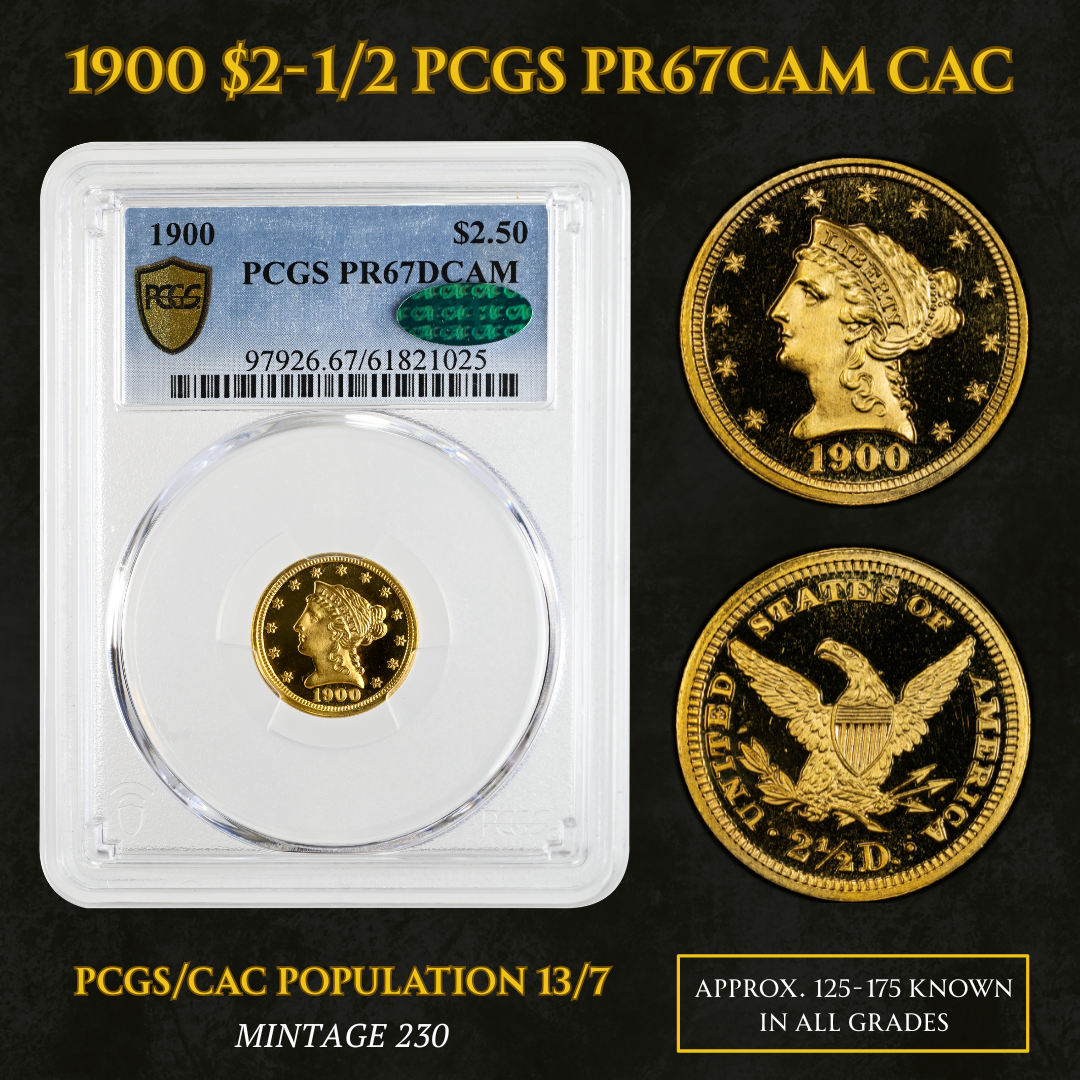
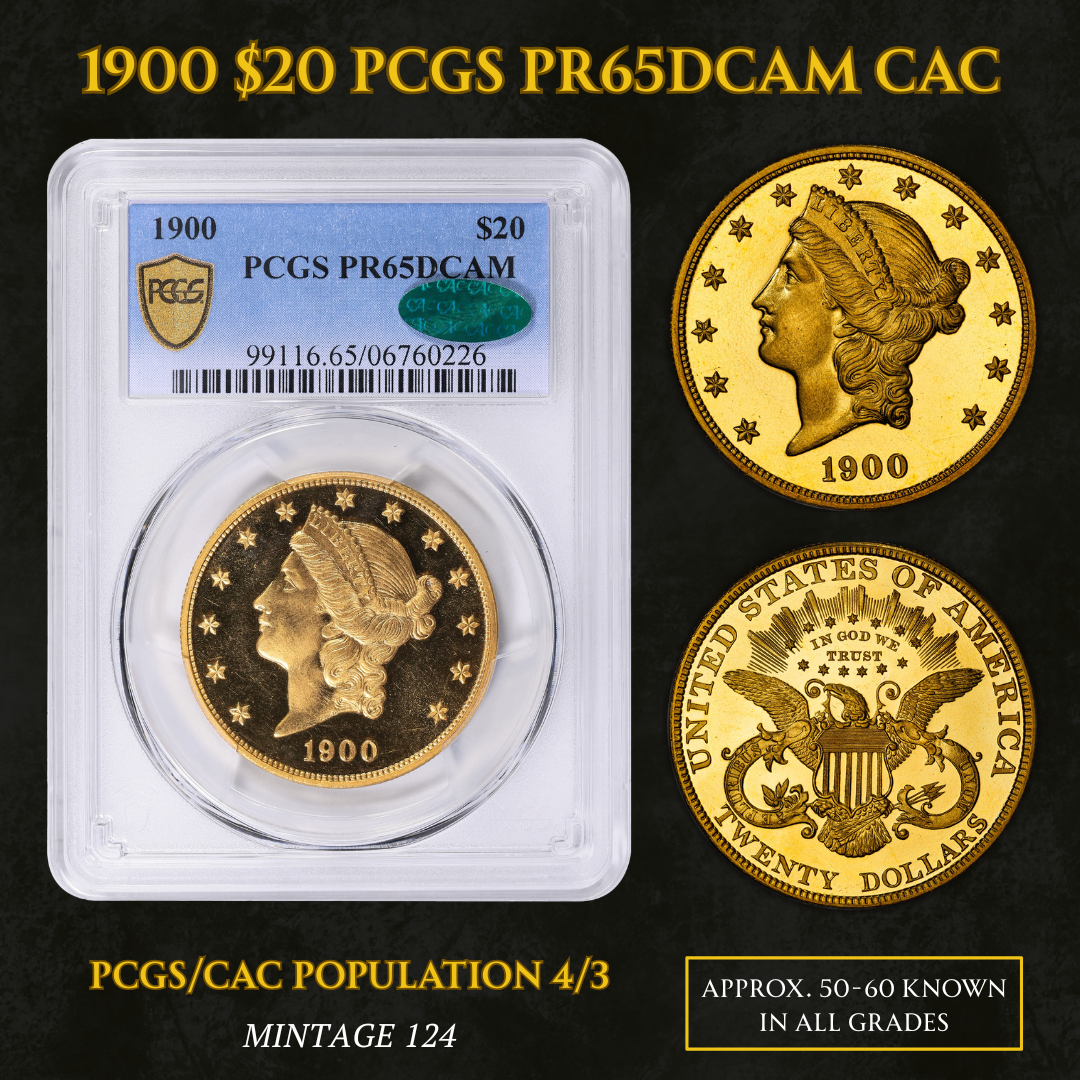
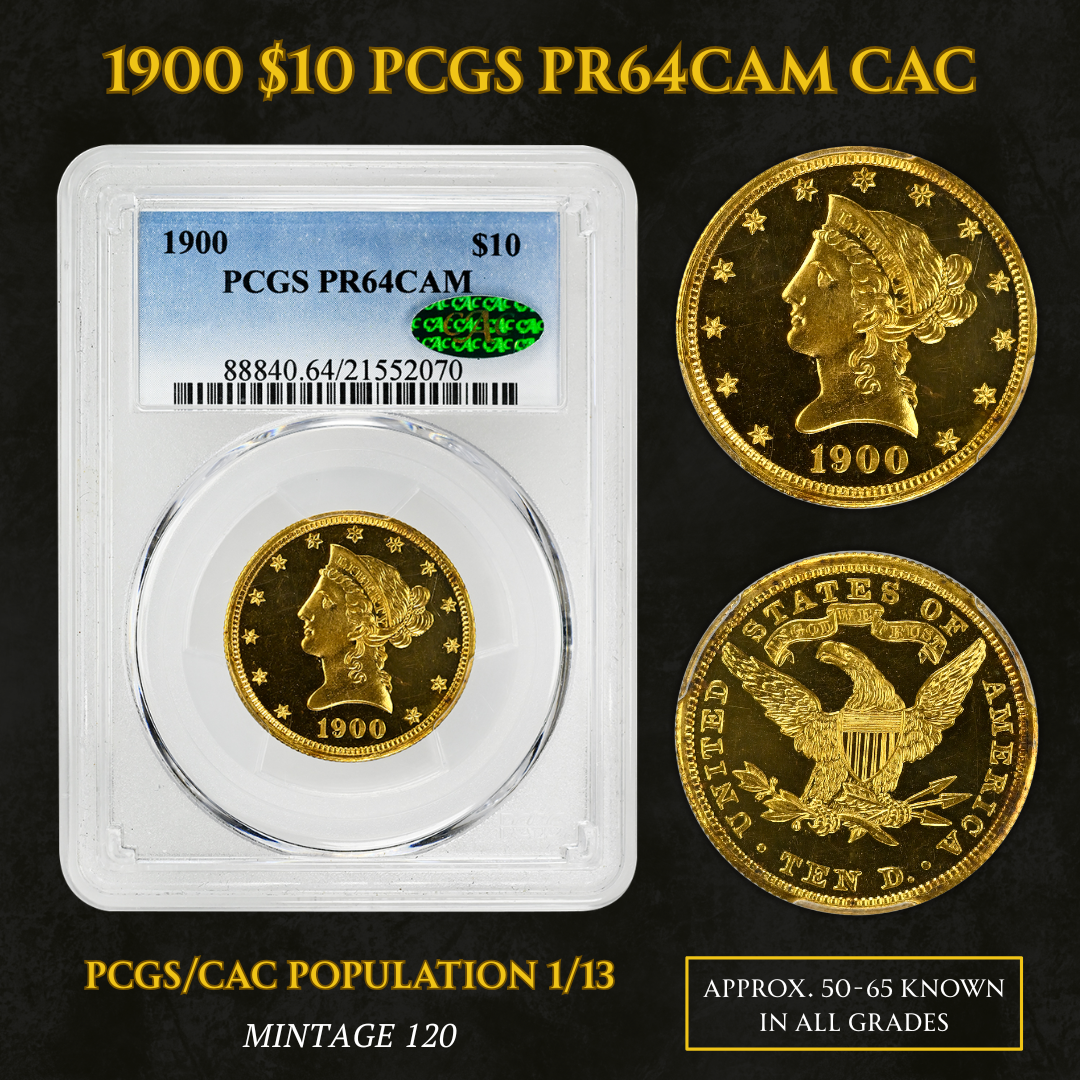
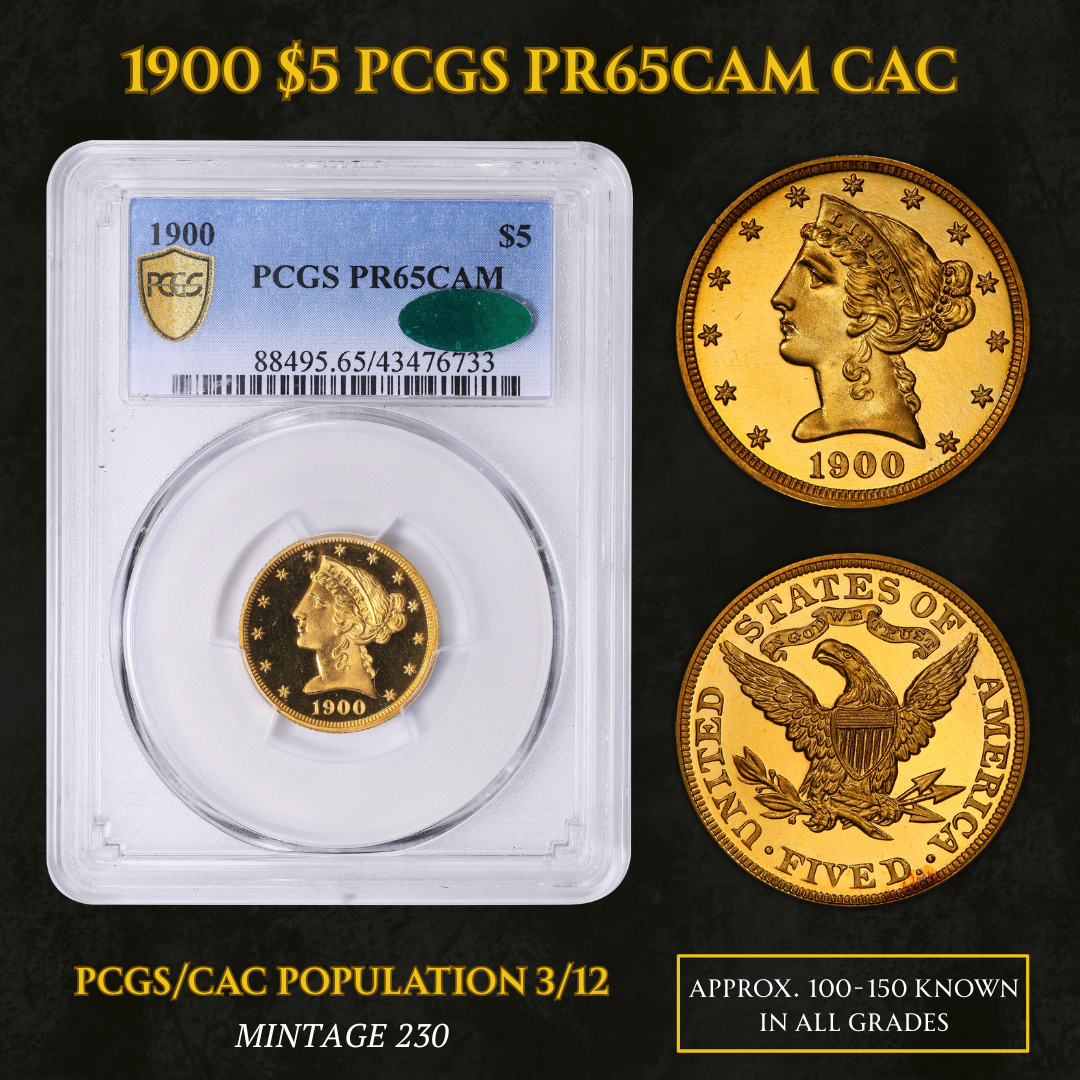
A complete 1900 Gold Proof Set consists of four denominations: the $2.50 Quarter Eagle, $5 Half Eagle, $10 Eagle, and $20 Double Eagle. These coins were not ordinary circulating gold pieces. They were Proof coins, specially struck with extraordinary care for collectors and presentation purposes. Their mirrored fields, sharply defined devices, and limited production make them among the most visually striking and historically meaningful coins of their era.
For the advanced collector, a set like this offers much more than gold content. It represents artistry, rarity, preservation, and a direct connection to America at the turn of the century.
A Rare Complete Set From a Historic Year
The year 1900 occupies a special place in American history. It marked the end of one century and the beginning of another. The United States was emerging as a major economic and geopolitical force, and gold coinage still played a central role in the nation’s monetary system.
That makes the 1900 Gold Proof Set especially desirable. These coins were produced during the final years of the Liberty Head gold design era, before the dramatic redesigns that would come under Theodore Roosevelt and Augustus Saint-Gaudens later in the decade. In that sense, the 1900 Proof gold issues represent the height of the traditional nineteenth-century U.S. gold coinage aesthetic.
The set is also extremely rare. The original mintage for a complete 1900 Gold Proof Set was only 120 sets. Individual denomination mintages were also very low, and the number of surviving examples today is far smaller than the original mintage figures might suggest. Many Proof gold coins were mishandled, impaired, cleaned, or lost over time. Others survive but do not meet the standards demanded by today’s most selective collectors.
This is why a high-quality 1900 Gold Proof Set is so difficult to assemble. It is not enough to locate four coins with the same date. The coins must have the right surfaces, eye appeal, certification, and overall presence. When a matched set appears with strong grades and Cameo or Deep Cameo contrast, it deserves serious attention.
Why Proof Gold Requires a Trained Eye
Classic Proof gold coins must be evaluated differently from regular business-strike gold coins. A Proof coin was made to showcase precision. The fields were intended to be reflective. The devices were meant to be sharp. The surfaces were supposed to display the skill of the Mint at its highest level.
Because of that, Proof gold is extremely unforgiving.
On a circulated gold coin, a small mark or abrasion may blend into the overall surface. On a Proof gold coin, that same mark can stand out immediately. The mirrored fields act almost like glass, revealing every hairline, contact mark, spot, or area of cloudiness.
This is one of the most important lessons I can give collectors: do not buy a classic Proof gold coin simply because it is labeled “Proof.” The designation alone is not enough. The quality within the grade matters tremendously.
Two coins may have the same numerical grade, but their value and desirability can be very different. One may have clean mirrors, strong contrast, original surfaces, and exceptional eye appeal. The other may be technically certified at the same level but suffer from hairlines, haze, weak contrast, or distracting marks.
In Proof gold, surface quality is everything.
Grading Implications: What Matters Most
When evaluating a coin like a 1900 Proof $20 Double Eagle, $10 Eagle, $5 Half Eagle, or $2.50 Quarter Eagle, I start with the surfaces.
The first thing I want to see is depth in the mirrors. A great Proof gold coin should have reflective fields that create visual depth when the coin is turned under light. The coin should not look flat or lifeless. It should have presence.
Next, I look for hairlines. Hairlines are one of the most common problems in classic Proof gold. Over the decades, many coins were wiped, cleaned, or handled improperly. Even light hairlines can materially affect the desirability of a Proof coin because they interrupt the mirrored surface.
A heavily hairlined Proof coin may still be certified, but it is not the kind of coin I want to own unless the price fully reflects the impairment. In many cases, lower-grade Proof gold coins in Proof-62 or Proof-63 holders can be problematic. That does not mean every coin at those grade levels should be dismissed, but the buyer must be extremely careful. The lower grade often reflects surface issues, and with Proof gold, those issues can be very visible.
I also pay close attention to marks, especially in focal areas. On Liberty Head gold coins, the cheek, neck, open fields, and central devices are critical. A single distracting mark in the wrong place can reduce the appeal of the entire coin. The larger the denomination, the more important this becomes. A Proof $20 Double Eagle has broad mirrored fields, and those fields leave very little room for forgiveness.
Cloudiness and blotchiness are also major considerations. Some original film or light haze may be acceptable if it is natural and does not detract from the coin. In fact, originality can be a positive. But unattractive cloudiness, uneven residue, or blotchy surfaces can materially reduce desirability.
Spots must be judged case by case. A tiny spot on an otherwise exceptional Proof gold coin may not be a serious concern. A large or dark spot, especially in a focal area, is a different matter. The question is always whether the issue distracts from the overall beauty and integrity of the coin.
Cameo and Deep Cameo Contrast
One of the most desirable characteristics in classic Proof gold is contrast.
A Cameo Proof has frosted devices set against mirrored fields. A Deep Cameo Proof has an even stronger version of that effect, with deeply frosted design elements and highly reflective fields. When viewed properly, a great Deep Cameo gold coin can have a dramatic black-and-gold appearance.
This contrast is not just attractive. It is rare.
Not every Proof gold coin was struck with strong frost. Not every coin retained its contrast over time. Handling, dipping, friction, and improper storage can all reduce the visual impact of a Proof coin. That is why Cameo and Deep Cameo designations can carry meaningful premiums, especially when paired with high numerical grades and strong eye appeal.
For many collectors, a Proof gold coin with bold Cameo or Deep Cameo contrast is far more desirable than a technically similar coin without contrast. The visual difference can be dramatic. The market often recognizes that difference, particularly for scarce dates and denominations.
In the 1900 Gold Proof Set, contrast is a central part of the appeal. A set with Cameo and Deep Cameo examples across the denominations offers the kind of visual strength that advanced collectors seek. The combination of rarity, grade, and contrast makes the set far more compelling than a group of ordinary Proof examples.
The Importance of Certification and CAC Approval
In today’s market, third-party certification is essential for classic Proof gold. PCGS and NGC grading provide an important foundation for authentication, grade, and market acceptance. CAC approval can add another layer of confidence, especially for buyers who want coins that are solid or premium for the grade.
However, certification should never replace personal judgment or expert evaluation. A holder can tell you the grade, but it cannot fully tell you the quality of the coin. The best buyers still look carefully at the mirrors, frost, originality, color, marks, and overall eye appeal.
With Proof gold, I want coins that look right. I want coins that have not been overworked, overconserved, or stripped of their natural character. I want coins with life.
A beautiful coin in the right holder, with strong eye appeal and CAC approval, is the kind of coin that tends to attract serious long-term collector interest.
Investment Potential of Classic Proof Gold
Collectors should always begin with quality and knowledge. Rare coins are not generic commodities, and they should not be purchased blindly. But certain coins do have characteristics that make them especially compelling from an investment perspective.
The 1900 Gold Proof Set has several of those characteristics.
First, it is genuinely rare. The original mintage was tiny, and the surviving population is limited. Complete sets are far more difficult to locate than individual coins.
Second, the set has historical significance. Coins from 1900 connect directly to the turn of the century, a period of American expansion, industrial growth, and monetary strength.
Third, the set has strong visual appeal. Proof gold is among the most beautiful areas of U.S. numismatics, especially when the coins display Cameo or Deep Cameo contrast.
Fourth, the set includes multiple denominations, which broadens its appeal. The $20 Double Eagle has size and presence. The $10 Eagle is an important and often underappreciated rarity in Proof format. The $5 Half Eagle and $2.50 Quarter Eagle add depth, balance, and collectibility.
In my opinion, Proof $10 Eagles and Proof $5 Half Eagles remain especially interesting. They are genuinely rare, difficult to locate with outstanding surfaces, and often trade at levels that do not fully reflect their scarcity when compared with other trophy-level U.S. gold coins. The $20 Double Eagle may receive the most attention because of its size and iconic status, but sophisticated collectors know that the smaller denominations can offer exceptional opportunity.
The key is selectivity. Not every Proof gold coin is a good investment. Problem coins, overgraded coins, hairlined coins, and unattractive coins can be difficult to resell and may underperform. The best long-term potential is usually found in coins with the right combination of rarity, grade, eye appeal, originality, and market recognition.
Why Sets Matter
A complete Proof gold set has a different kind of appeal than a single coin. It tells a fuller story. It shows the range of U.S. gold denominations from that year and allows the collector to appreciate the artistry and production quality across multiple designs and sizes.
Sets are also difficult to recreate. Individual coins may come to market, but assembling a matched set with the right grades, designations, and overall appearance can take years. In some cases, it may not be possible at all.
That scarcity of opportunity is part of what makes a high-quality 1900 Gold Proof Set so important. It is not just four rare coins. It is a complete numismatic statement from one of the most historically significant years in American gold coinage.
The 1900 Gold Proof Set represents the intersection of history, artistry, rarity, and investment potential. These coins were struck at a time when the United States was entering a new century with confidence and ambition. More than 125 years later, they remain among the most beautiful and desirable artifacts of that era.
For collectors, the lesson is simple: buy quality. Look for clean mirrors, strong contrast, original surfaces, attractive color, and minimal distractions. Be cautious with hairlines, cloudiness, blotchiness, and marks in focal areas. Do not assume that every certified Proof gold coin is equal.
For investors, the opportunity lies in rarity and selectivity. The best classic Proof gold coins are difficult to replace, visually compelling, historically meaningful, and supported by a sophisticated collector base. A complete 1900 Gold Proof Set with strong grades and Cameo or Deep Cameo contrast is exactly the kind of material that deserves serious consideration.
In numismatics, true quality is always scarce. The 1900 Gold Proof Set reminds us why the finest rare coins are not just collectibles. They are pieces of American history preserved in gold.
PROTECT YOUR WEALTH. CONTACT US TODAY
If you are interested in protecting or even growing your wealth through the investment of rare coins, we invite you to contact us. At Tangible Investments, we have over 40 years of numismatic expertise and are proud members of PCGS, CAC, and PNG. One of our experts can guide you in reaching your financial goals, ensuring that your investments are tailored to your specific needs and objectives.