
Why the 1854-O Double Eagle Is One of America’s Great Gold Rarities
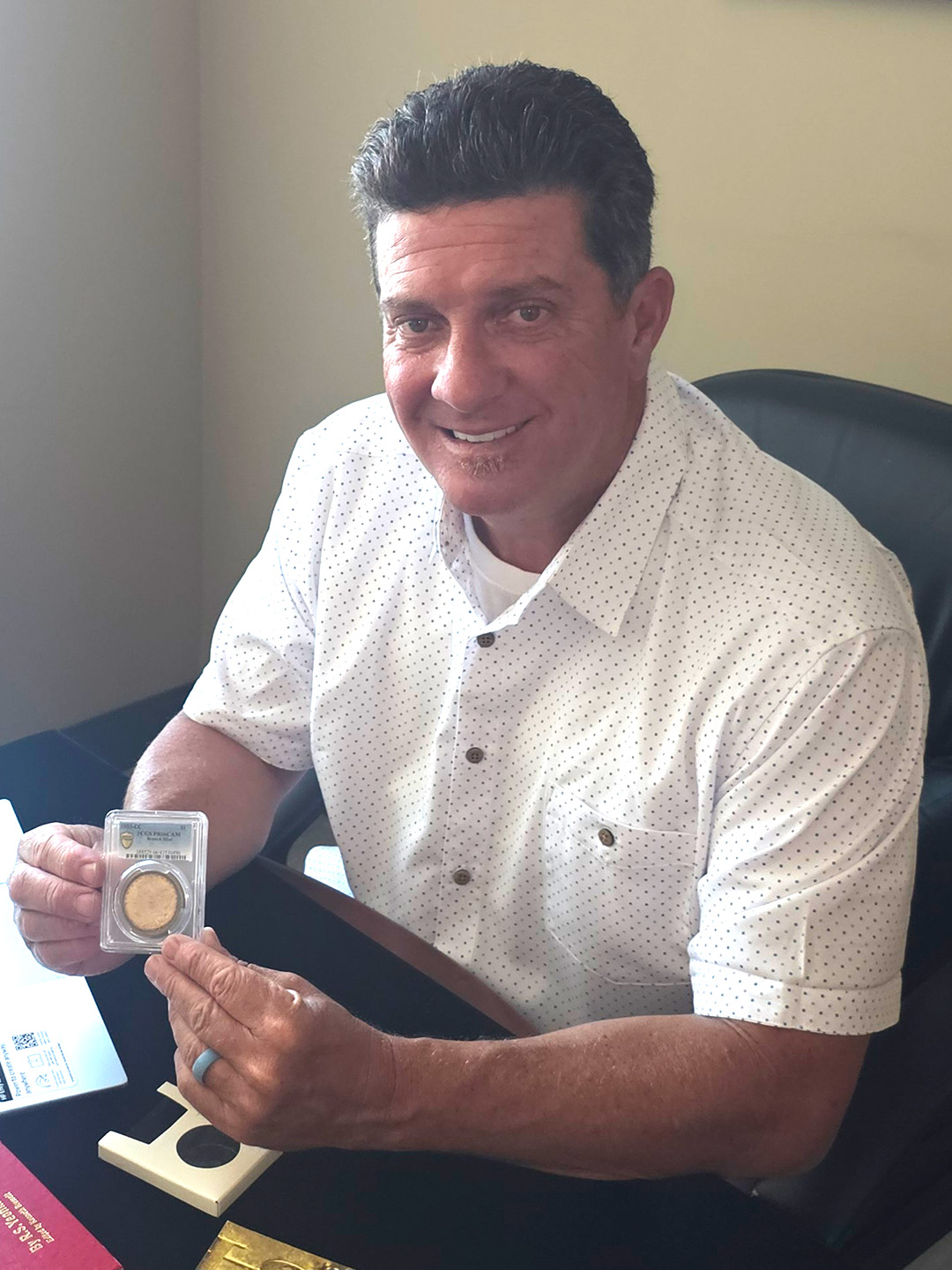
By Michael Smith, Coin Specialist/ Private Client Sales/ Wholesale
“This is not simply a scarce date needed to fill a space in an album. It is the kind of coin around which an advanced collection is built.”
A mintage of 3,250 coins gets your attention. An estimated surviving population of only 40 changes the conversation entirely.
That is the story of the 1854-O Liberty Head Double Eagle. The original production figure would be enough to distinguish almost any 19th-century United States gold issue, but the number of coins believed to remain is what makes this date exceptional. PCGS estimates that just 40 examples survive in all grades and reports no known Mint State survivor. That places the issue among the most formidable absolute and condition rarities in the entire Liberty Head Double Eagle series.
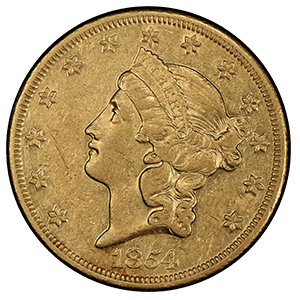
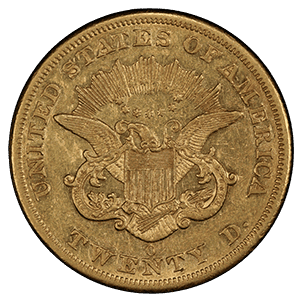
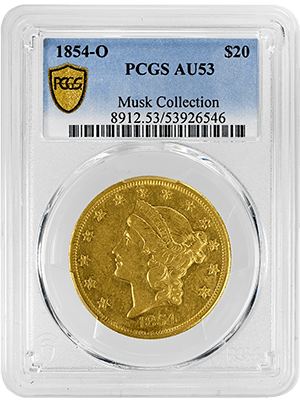
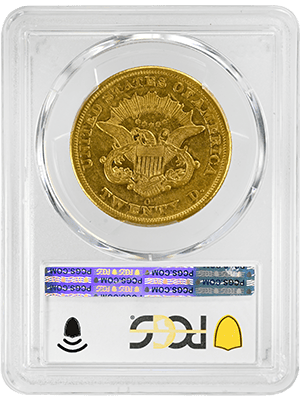
We are currently offering an especially desirable example graded AU53 by PCGS. With attractive honey-gold surfaces, strong remaining detail, and significant luster for the grade, the coin occupies an important place near the upper end of the surviving population. This is not simply a scarce date needed to fill a space in an album. It is the kind of coin around which an advanced collection is built.
A $20 Coin Born From the California Gold Rush
Congress authorized the double eagle in the Act of March 3, 1849, creating a new $20 denomination at a moment when California gold was transforming the nation’s economy. The United States Mint notes that the double eagle was first produced in 1849 to support the enormous flow of gold created by the California Gold Rush.
Chief Engraver James B. Longacre adapted the Liberty Head motif for the new denomination. The obverse presents Liberty wearing a coronet inscribed LIBERTY, surrounded by 13 stars. The reverse features a heraldic eagle beneath a field of rays, with the denomination expressed as TWENTY D. on this early Type One design. The result was physically substantial: PCGS records the coin at 34 millimeters in diameter, 33.40 grams in weight, and a composition of 90 percent gold and 10 percent copper.
The New Orleans Mint gave the series a distinctive Southern chapter. Established to convert regional bullion and foreign coin into federal money, the branch mint struck gold and silver coins for an economy closely connected to the Gulf Coast and international trade. Its “O” mintmark became one of the most evocative symbols in American numismatics.
The Mintage Collapsed in 1854
The production history of New Orleans double eagles makes the 1854-O stand apart immediately. The mint struck 315,000 double eagles in 1851, 190,000 in 1852, and 71,000 in 1853. In 1854, output fell to only 3,250 pieces.
That decline coincided with a major change in the nation’s minting network. The San Francisco Mint opened in 1854, allowing more California gold to be coined much closer to its source. The amount of bullion reaching New Orleans for conversion into $20 pieces diminished sharply. The surviving 1854-O coins are therefore artifacts of a turning point, when the geography of American gold coinage shifted westward.
Here is the important distinction: low mintage does not automatically create a great rarity. A coin can begin with limited production and still remain obtainable if enough examples are recognized and saved. That did not happen with the 1854-O.
These Coins Were Money, Not Collectibles
In 1854, a double eagle represented serious purchasing power. These coins were issued to move value efficiently, not to satisfy a mature market for mintmarked rarities. Most entered commercial channels, where they accumulated wear, contact marks, and abrasions. Others traveled overseas as settlement for international obligations and were eventually melted. Still more disappeared during later cycles of recoining.
Contemporary collectors generally did not pursue branch-mint gold by date and mintmark with the intensity seen today. There was little reason for someone handling a newly issued 1854-O to recognize that its production would prove dramatically lower than nearby dates, much less to remove a pristine example from commerce. The opportunity to preserve an original Mint State population was lost before the issue’s true importance became widely understood.
This is why I always separate mintage from true availability when evaluating a rare coin. Mintage tells us how many were made. Survival tells us what a collector can realistically hope to acquire today.
PCGS currently estimates 40 examples in all grades. Numismatic specialist Doug Winter has separately estimated approximately 30 to 40 known pieces. Population reports alone cannot establish the number of distinct surviving coins because valuable rarities are sometimes resubmitted to grading services. Even with that qualification, the repeated market appearances and pedigrees of major specimens support the same conclusion: the total population is remarkably small.
AU53 Is a Significant Grade for the Issue
Collectors sometimes look at AU53 and focus first on the fact that the coin circulated. With the 1854-O, that is the wrong starting point. The grade of About Uncirculated 53 carries unusual importance precisely because the issue has no known Mint State representative. PCGS ranks the 1854-O first in condition rarity among all 148 Liberty Head Double Eagle issues at the Mint State threshold, and tied for second in overall rarity across the series.
Most known examples show the effects of meaningful circulation. PCGS CoinFacts notes that surviving pieces are often heavily abraded and that many retain little mint luster. Higher-grade coins can exhibit reflective or semi-prooflike character, a logical consequence of the very small production run. Natural color and convincing eye appeal are particularly prized because numerous survivors have been cleaned or otherwise impaired.
The AU53 example we are offering retains strong definition through Liberty’s hair, the surrounding stars, and the reverse eagle. Its honey-gold color, remaining luster, and balanced visual presentation make it a compelling representative of a date for which collectors cannot simply wait for an uncirculated alternative. In this context, AU53 is not a compromise grade. It is a serious collector grade within a population whose finest certified examples remain circulated.
A Defining New Orleans Double Eagle
Within the Type One Liberty Head Double Eagle series, the 1854-O and 1856-O have long been recognized as the two great New Orleans rarities. PCGS describes ownership of an 1854-O as a hallmark of a truly great Liberty Head Double Eagle collection. That reputation rests on more than a low number in a mintage table.
The coin brings together several qualities that sophisticated collectors consistently value:
-
A famous absolute rarity with an estimated surviving population of roughly 40 coins
-
A historically important Southern branch-mint origin
-
A direct connection to the redistribution of California gold and the opening of the San Francisco Mint
-
A place among the key issues of the Type One Liberty Head Double Eagle series
-
Exceptional condition rarity, with no Mint State survivors recognized by PCGS
-
Strong demand from date collectors, type specialists, New Orleans enthusiasts, and advanced U.S. gold collectors
It also has the benefit of immediate recognizability. To a knowledgeable collector, the date and mintmark say nearly everything. To someone encountering the issue for the first time, the scale and gold content of the double eagle give it an undeniable physical presence. It works on both levels: as a celebrated rarity and as an impressive historic object.
Certification Matters at This Level
An issue this rare requires disciplined authentication and evaluation. PCGS certification confirms the coin’s authenticity and provides an independent grade, but expert judgment remains essential. Strike quality, surface character, color, luster, eye appeal, and provenance can materially distinguish one certified example from another.
Genuine 1854-O double eagles also share diagnostic characteristics. PCGS CoinFacts notes the small date rising slightly to the right, raised die lumps near the letters TY in LIBERTY, and another small raised die lump on Liberty’s neck near the largest curl. These diagnostics help separate the New Orleans issue from 1854 double eagles produced in Philadelphia and San Francisco.
Buyers should verify the holder’s certification number directly through PCGS and work with a numismatic firm capable of evaluating both the grade on the label and the coin inside the holder. My role at Tangible Investments is to help private clients and wholesale buyers understand those distinctions, because two coins with the same numerical grade can present very differently in hand. Tangible Investments brings more than 40 years of market leadership, over $2 billion in transactions, and the perspective of a PCGS co-founder to that process.
When I evaluate a coin at this level, I look for a combination of factors rather than a single impressive statistic. The 1854-O delivers all of them. Only 3,250 were struck. Approximately 40 are estimated to survive. None is recognized by PCGS as Mint State. Its New Orleans origin places it within one of the most closely followed areas of 19th-century American gold, while its status beside the 1856-O gives it trophy-level importance within the series.
The PCGS AU53 example we are now offering presents an uncommon opportunity to acquire this celebrated rarity in a high-end circulated grade, with strong detail, attractive color, and meaningful remaining luster. For the collector assembling a serious Liberty Head Double Eagle set, a New Orleans gold collection, or a cabinet of landmark American rarities, the 1854-O deserves consideration not simply as another key date, but as one of the defining gold coins of its era.
Inquire About the 1854-O Double Eagle
Opportunities to acquire an 1854-O Liberty Head Double Eagle are exceptionally rare. If you would like additional information about this PCGS AU53 example, including availability and private-client pricing, please complete the form below. A Tangible Investments coin specialist will contact you directly.